Artikel: Is Crate Training Cruel? Door Open, Closed, or No Door
Is Crate Training Cruel? Door Open, Closed, or No Door
Post a photo of a dog napping in a crate, and the comments split within the hour. One person writes, "Poor thing, locked in a box." Another says it was the best decision they made with their puppy. A third links a news story about crates being banned in Sweden. All three love dogs. Most of the time, they're not even arguing about the same thing.
We make dog houses, some with doors and some without, so we hear this question a lot. Here's what we've learned, from the research, from animal welfare groups on both sides of the Atlantic, and from years of customer photos: the crate itself decides very little. How you use it decides almost everything.
Why is crate training so controversial?
Partly because "crate training" means very different things in different countries.
In the US, a crate is standard equipment. Breeders send puppies home with one, shelters recommend it, and the American Kennel Club has step-by-step guides. Vets also prescribe strict crate rest after spinal or orthopedic surgery, when a dog really does need to stay still for weeks.
In the UK, the view is "yes, with conditions." The RSPCA supports crates as a den and a safe space, but says they must never be used as punishment, and that shutting a dog in one all day while you're at work is never acceptable.
Germany is stricter. The German Federal Veterinary Chamber reads the 2022 update to the national dog ordinance as allowing a closed box only for transport or on veterinary advice, and suggests about 30 minutes as a rough limit for short closures. The German Kennel Club (VDH) has called it a legal gray area, since the law never clearly separates "keeping" a dog from "briefly placing" it somewhere.
And then there's Sweden, which is where the "illegal" headlines come from. Swedish rules don't allow a dog to be kept in a closed cage at home, not even for a short while. Transport, shows, hunting and vet-related situations have their own rules. What most articles leave out: an open crate used as a bed is fine, as long as the door is removed or fixed so it can't swing shut.

So when an American says "my dog loves his crate" and a Swede says "that's cruel," they're often picturing two different scenes. One is a puppy dozing with the door open while the family cooks dinner. The other is a dog behind a latched door for nine hours. Nobody is defending the second one, not even the biggest crate fans.
Is crate training cruel? What the research says
There isn't a huge amount of research, but one study is worth knowing. A team surveyed 1,305 dog owners in 23 countries. About a quarter had used a crate. Most of those dogs were puppies of six months or younger, and the crate was mostly used for training.
Owners reported low levels of distress overall, and said training goals, like house training, were easier to reach than behavioral ones. The important part: signs of distress went up noticeably when the crate was used to deal with behavior problems. The authors' conclusion was that crates can work well for education and do little good as a fix for a dog who is already struggling.
While we're here, one popular argument deserves a second look. You've probably heard that dogs are "den animals" and naturally love small enclosed spaces. Many trainers and behaviorists don't buy it: wild canids use dens mostly to raise pups, not as a place to spend the day. Plenty of dogs do enjoy a cozy covered spot. That's a preference, though, not proof that a closed door is natural.
So, is crate training cruel? Used as a short-term training tool, introduced slowly and never as punishment, the evidence says no. Used to store a dog for most of the day, or to contain anxiety instead of treating it, it can do real harm. The crate is the same in both cases.
Crate door open or closed? It depends on the situation
This is probably the most practical question, so here's how we'd think about it. One note first: if you live in Sweden or Germany, closing the door at home is restricted by law, so check your local rules before you use any of the closed-door options below.

A new puppy, especially at night. This is where a closed door helps most. A puppy who can't wander off can't chew a cable or pee behind the sofa at 3 a.m. Put the house next to your bed so the puppy can hear and smell you, and plan on getting up for toilet breaks. Our puppy potty training guide covers that part.
Recovery after surgery or injury. If your vet prescribes crate rest, follow it. This is one situation where even the strictest European rules make an exception.
Visitors, other pets, a busy moment. A few minutes behind a closed door while a delivery comes in or a toddler runs around can make things calmer for everyone, provided the dog already sees the house as a good place.
A calm adult dog at home. Leave the door open. Once a dog has learned that the house is theirs, there's usually no reason to close it. You'll often find them in there anyway.
A dog with separation anxiety. Don't close the door and leave. The AKC specifically warns against crating anxious dogs, who can hurt themselves trying to get out. Work with a trainer or a veterinary behaviorist instead.
Should I crate my dog at night?
If your puppy is young and not yet house-trained, a closed door at night, with the house right by your bed, is a common and reasonable choice. As your dog grows and becomes reliable, try the door open for one night, then another. Many dogs keep sleeping in the same spot without the door ever being closed again.
How long can a dog be in a crate?
The guidance varies, but it points in one direction. Humane World for Animals (formerly the Humane Society of the United States) suggests no more than three or four hours at a time for puppies under six months, and about four to five hours for adults during the day. The UK's PDSA says no more than three hours at a time, and less for dogs who aren't used to it. The RSPCA says a well-adjusted adult is usually fine for about three hours.
Keep in mind that being home alone and being alone behind a closed door are different things. A dog who can move around a safe room can manage a longer stretch than a dog who can't. We wrote about the first one in How Long Can a Dog Be Left Alone?
If you use the door: close it last
Most crate problems come from closing the door too early. The dog's first experience is being shut in, and everything after that is about getting out. Turn the order around.

- Door open, and fixed open. A door that swings and bangs can scare a puppy off for weeks. Just let the house be there.
- Make it the place where good things happen. Drop treats inside. Hide a toy. Let your dog find them without any pressure.
- Serve meals inside. Start with the bowl at the entrance, then move it further back over a few days.
- Close the door for a few seconds while they eat, then open it before they finish. You want the door to open before your dog asks.
- Stretch the time slowly, with you sitting nearby. A long-lasting chew helps.
- Step out of sight for short moments, and come back calmly, without a big greeting.
This can take a few days or a few weeks. If your dog whines, go back a step. Letting them "cry it out" is something the AKC advises against, and it usually undoes the progress you've made.
If you skip the door: make the open house the obvious choice
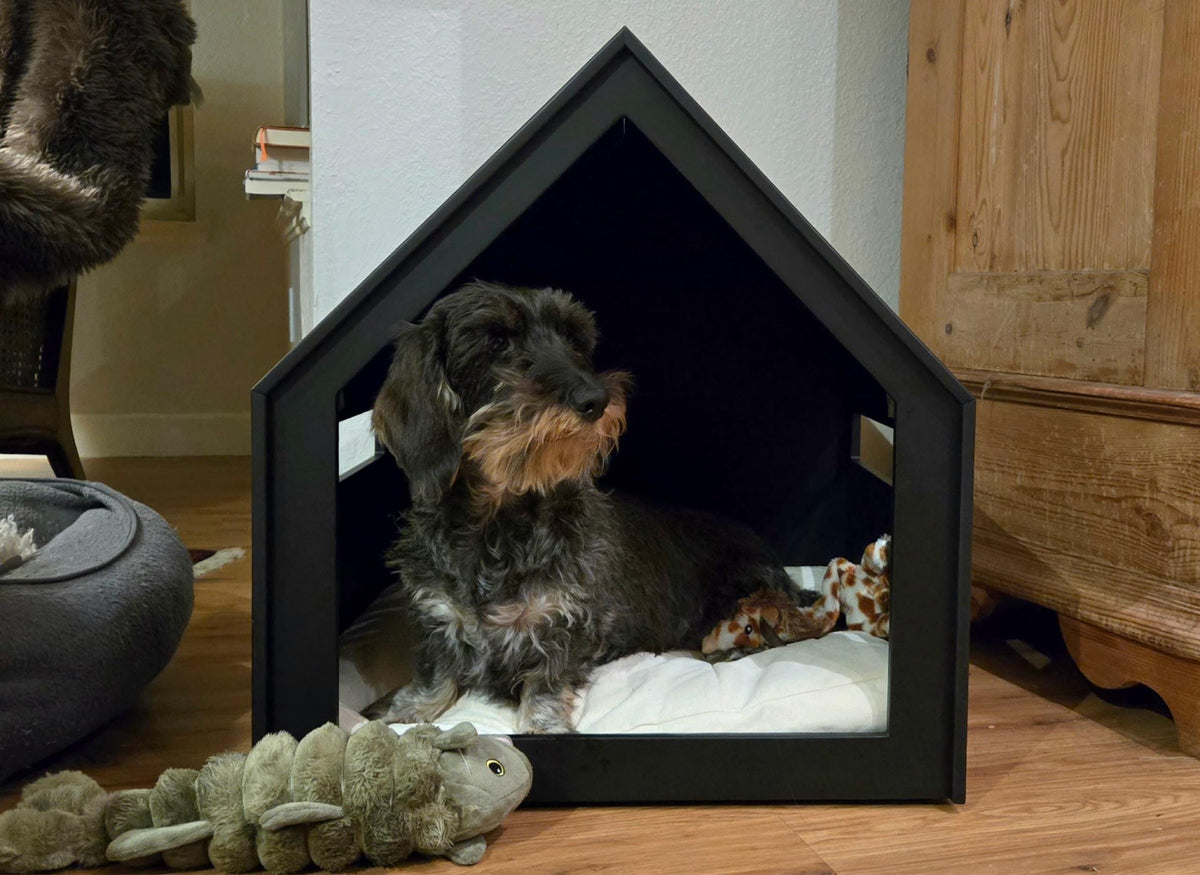
Some owners never want a door, and plenty of dogs do great without one. Choosing an open house (a dog crate alternative, if you like) still takes a bit of thought. A dog bed dropped in a corner is easy to ignore. A house the dog has picked as their own gets used every day.
- Put it where life happens, not in a laundry room. Dogs like to rest near their people, just a little out of the way. The corner of the living room is usually better than a spare room.
- Give it a roof and walls. A covered space feels more sheltered than an open bed, which is why dogs often choose the spot under a desk.
- Use a cushion that smells like home. A worn T-shirt under the cover helps during the first days.
- Make it off-limits to everyone else. When the dog goes in, nobody reaches in, drags them out or climbs in with them. This matters most with kids. We explain why in Does Your Pet Need Personal Space?
- Reward them for going in on their own. A quiet "good" and a treat is enough.
Without a door you'll need other ways to keep a young puppy safe when you can't watch them, like a puppy-proofed room or a baby gate. That's the approach most Swedish and Finnish owners use.
Is it working? Watch your dog, not the door
Whichever route you take, your dog will tell you how it's going.

Good signs: your dog walks in on their own, lies down with a loose body, sleeps deeply and sometimes stretches out on their side. Warning signs, many of them listed by the AKC: pacing, shaking, scratching or biting at the door, whining that builds instead of fading, drooling or heavy panting while resting. If you see these, slow down, open the door and go back a few steps.
What makes any dog house a bad one
This part applies to open houses too. A dog house turns into a bad place when:
- It's used as punishment. "Go to your house!" said in an angry voice teaches a dog to avoid it. You don't need a door to make that mistake.
- It's used to hide a problem. Chewing, barking and panic when alone need training, not a latch.
- It's the wrong size. Your dog should be able to stand up, turn around and stretch out. For our houses, measure your dog lying down and stretched out, then add about 4 inches (10 cm).
- It's in the wrong spot. Next to a radiator, in a draft, in full sun or in a room nobody goes into.
- Nobody asks the dog. Some dogs love a door, some ignore it, and some never feel right behind one. Each dog is different, and that's fine.
Why every PetSo house works both ways
We don't think you should have to choose a side before you've met your dog. That's why we design our houses so the door is a choice, not a requirement.
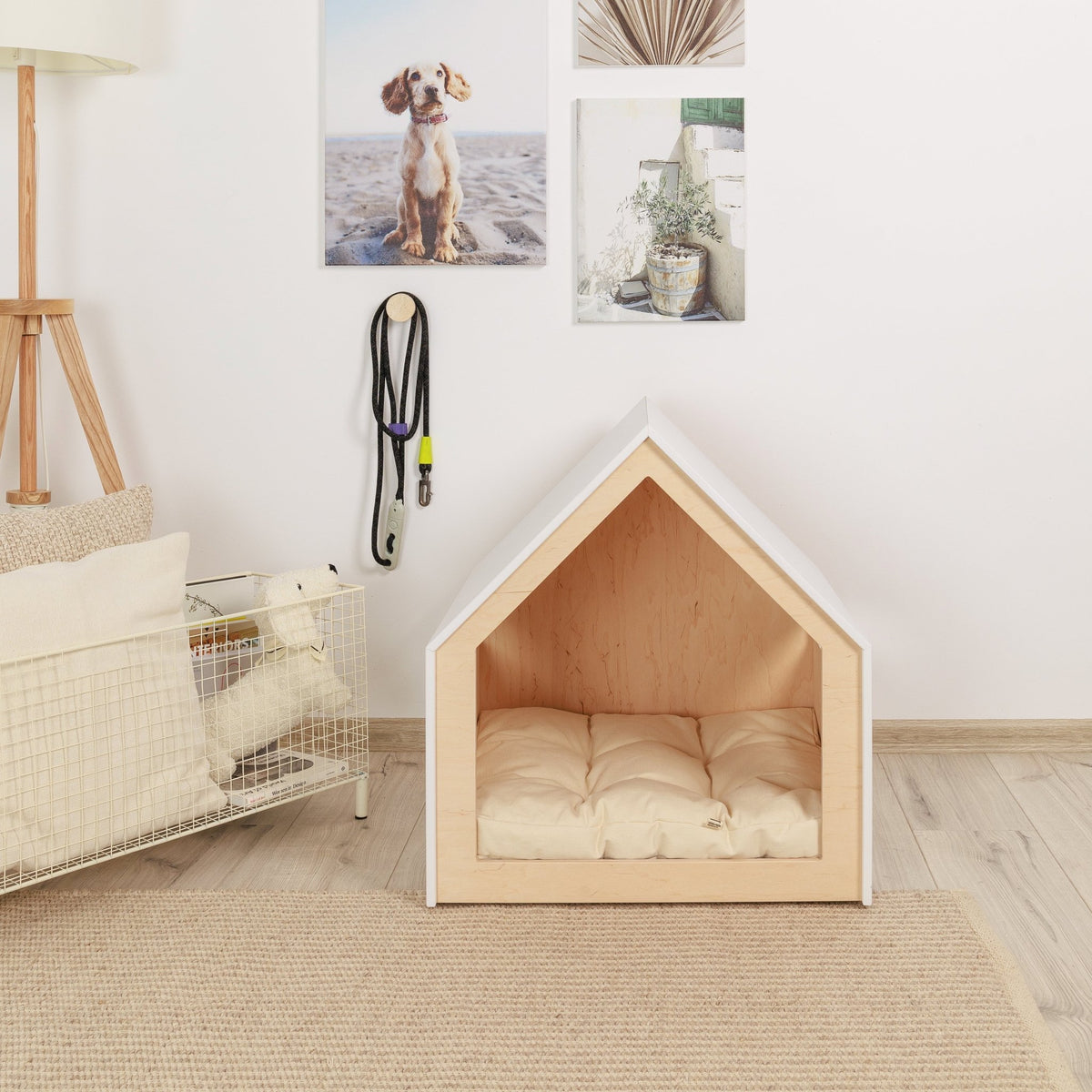
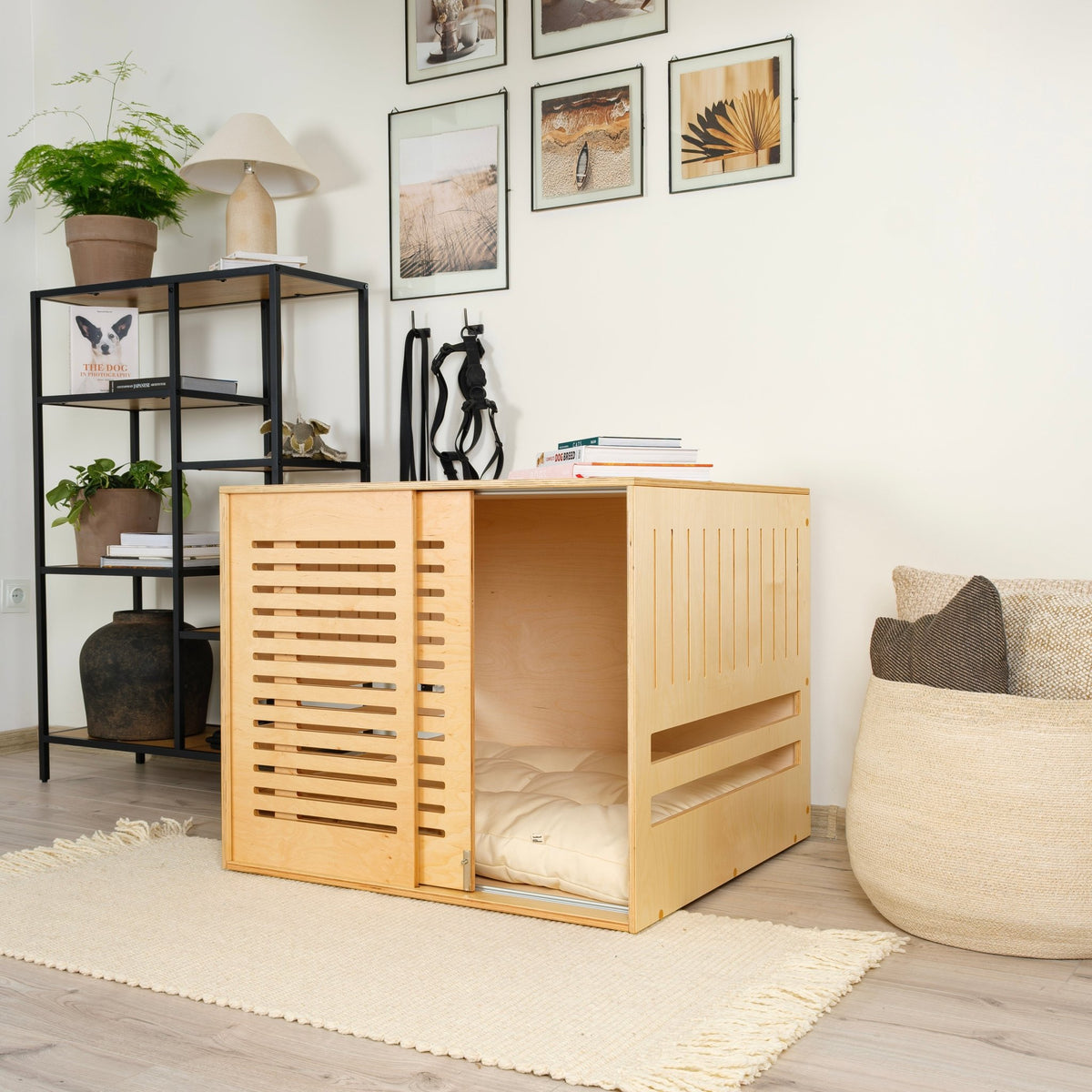
- Every PetSo house with a door can stay open all the time. Close it during the puppy months, then leave it open for good. The house stays the same, and so does your dog's favorite spot.
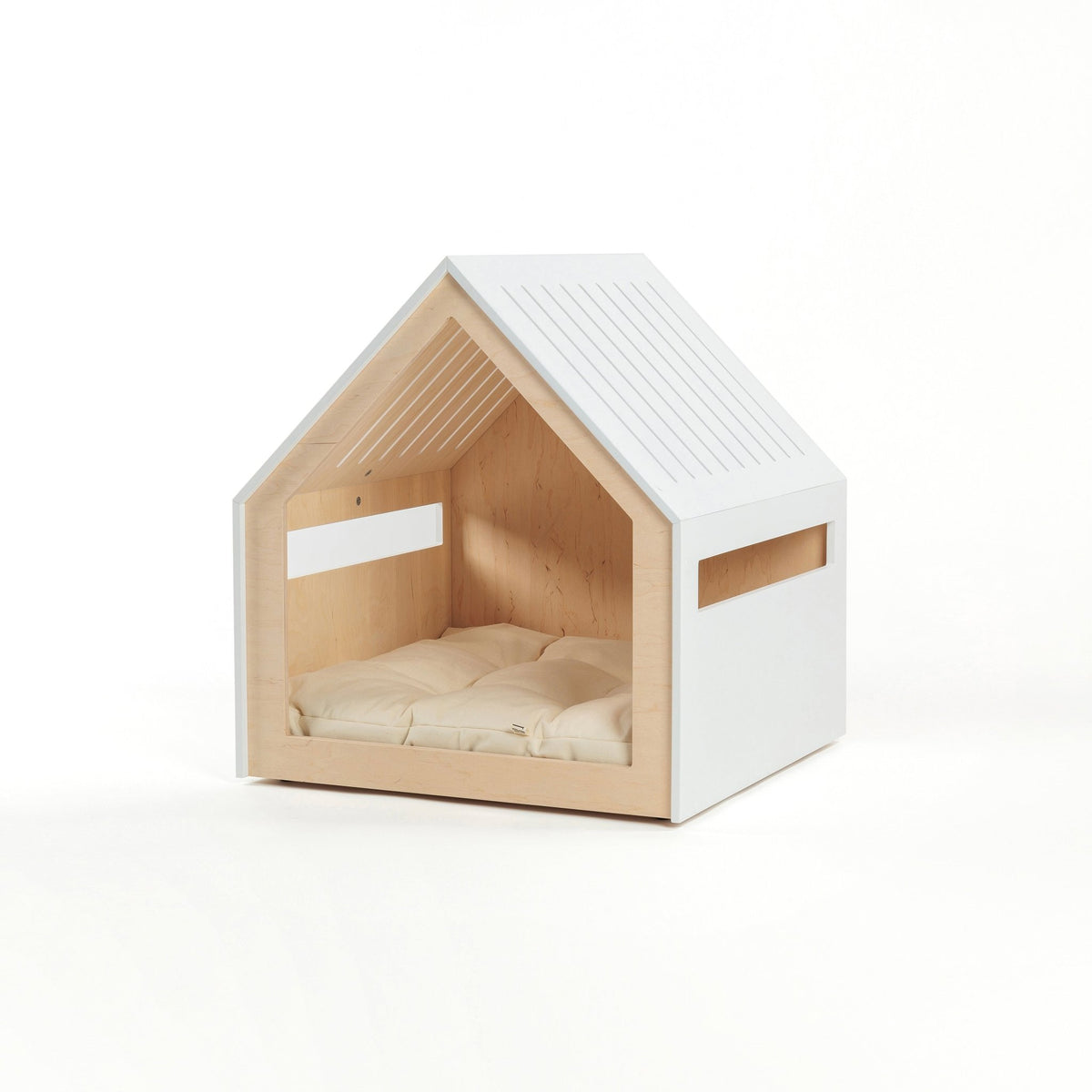
- Want no door at all? The Petso Classic Open is our pitched-roof house without a door, and many of our other models also come in a version without one.
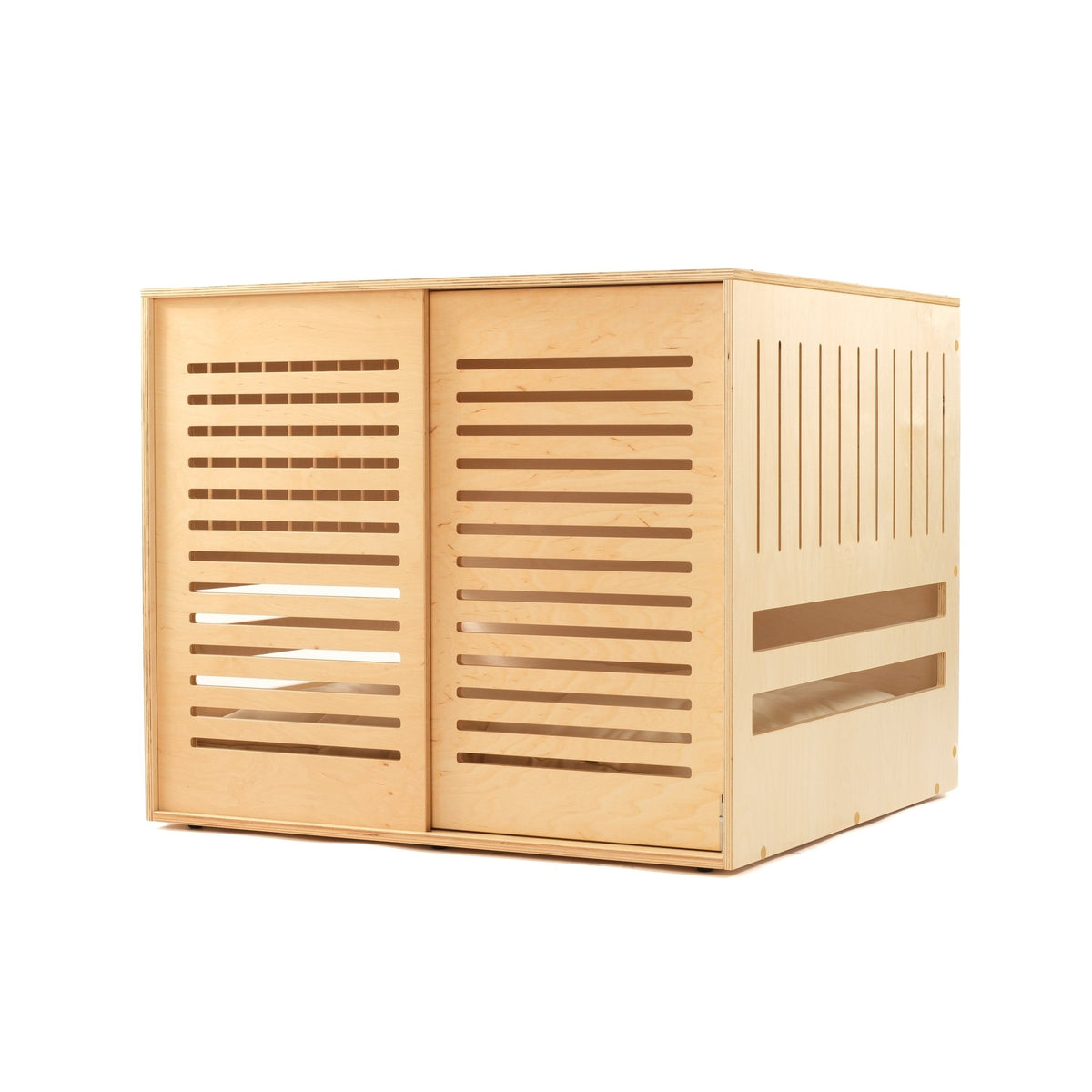
- Sliding doors stay out of the way. On the Dordrecht Coupe, the doors slide instead of swinging out, so an open door doesn't stick out into the room or swing into your dog.
- It looks like furniture. Birch plywood, clean lines and a soft cushion. Nobody who visits will think "cage," because it isn't one.
Browse our pitched-roof houses or flat-roof crates. If you're between sizes, send us your dog's measurements and we'll help you choose.
Quick answers
Is crate training necessary?
No. It's one useful tool for house training, travel and recovery, but plenty of dogs are raised without it, with a safe room, a gate and close supervision instead.
Why is crate training illegal in Sweden?
Swedish animal welfare rules put a high value on a dog's freedom to move, so keeping a dog in a closed cage at home isn't allowed. Crates are allowed for transport, shows and vet-related situations, and an open crate used as a bed is fine if its door can't close.
Dog crate or bed: which is better?
For a young puppy, a house with a door gives you more options. For a settled adult dog, an open covered house often works best: it feels sheltered like a crate and stays as open as a bed. A house with a door that you leave open does both.
Can I crate train an older dog?
Yes, but take it even more slowly, and keep the door open for longer. Senior dogs with sore joints shouldn't be confined for long periods, and a thick cushion helps.
In the end, the question isn't really "crate or no crate." It's whether your dog has a place that belongs to them, and whether they go there because they want to. A door can help with that or get in the way, depending on how you use it.
Sources: RSPCA — Crates · PDSA — Crate training · AKC — How to crate train your dog · Humane World for Animals — Crate training · The cage as an educational and therapeutic tool for dogs (Applied Animal Behaviour Science) · Bundestierärztekammer — Hundeboxen (DE) · Länsstyrelsen — Hund och katt i bur (SE) · Modern Dog — Do we crate too much?. This article is general information, not veterinary or legal advice.